Take the 49 indeed

Tonight on the bus I met a really nice lady named Lulu who was reading a Mayan/ English phrase book and had some stunning eye makeup. We chatted about antifascist things and she was telling me stories about the 60s and I dunno, hanging out with Jefferson Airplane and all that sort of thing and I guess she taught herself some Mayan back then because of trying to work at a fancy bookstore where they didn’t hire her but did give her a free book on Mayan?! The one that the Mexican government published in the 1930s. I can’t remember all the things we talked about and have forgotten interesting details like the name of the specific bookstore, but I did give her a tiny zine while also saying with regret that I have no time to a) actually learn Mayan b) come to a labor organizing thing in North Beach of Mayan and Mam speaking restaurant workers! So maybe we will meet again. I thought of inviting her to the Soiree (since she had a walker, she would fit right in) but she was on her way to the labor thing. I also felt a nice feeling like OK maybe when I am 75 I will be riding the bus still with all my flamboyance and reading interesting books and meeting people. I hope so!

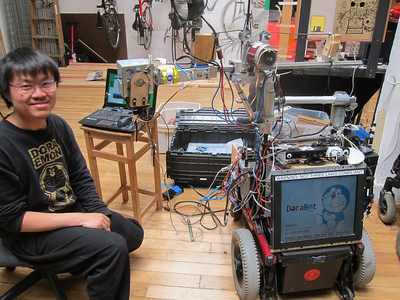
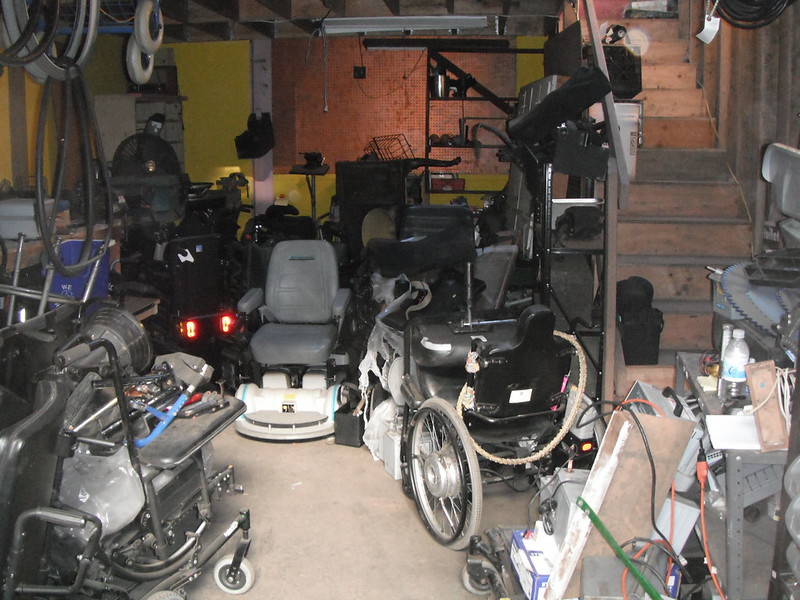
Onward to my event which was the “Wine and Chocolate Soiree” fundraiser (a criperati thing) where I got to have nice conversations with some of my friends who work for that org while drinking champagne and dipping tiny creampuffs and chunks of poundcake into a chocolate fountain in the Green Room above the opera house. THAT IS JUST HOW THEY ROLL. once a year they splash out and have a little gala. Maybe nonprofits get to rent it cheap. So I’m hanging out with Vince and his friend Ben and they told me about an accessible “ninja” course they made at some school in atherton (?) and then we were coming up with the best ideas for a wheelchair driven remotely with a glow in the dark life size Halloween lawn decor skeleton and a sign that says STILL WAITING FOR UNIVERSAL HEALTH CARE or whatever, that we would drive around town. Vince said to look up something from brooklyn called Devil Baby where they haad some sort of prank stroller where you go look in and YAAAAAAAH DEVIL BABY pops out. OK!!! Time for another glass of free champagne!

Then this lady comes up to me and goes Oh is that a Pansy Division tshirt! Yes it is. Oh I played with them once! Oh really what was your band. Well do you know who I am, I’m J* L*R*y! I started laughing uproariously! I am sure my face was doing many strange things that I had zero control over.

Anyway, I blurted, Oh, that’s so highlarious!!! Because, I’m like, a micro niche famous hoax identity debunker! Hahahaha!

I was treated to some backstory which I mostly knew anyway because I do have a little side hobby sometimes of being interested in people’s (literary/blog) hoax identities!

So, that happened….

A few creampuffs later I dipped to return to the 49 bus stop where unfortunately a man was laughing to himself insanely with his pants down, jerking it in the middle of Van Ness and MacAlister right across from City Hall. I had some conflicted thought such as, well, he is just a sad and unhinged person who really doesn’t seem to know much about what is up, and he isn’t like, LOOKING at anyone, hes just like staring off into space in the other direction and guffawing? But I don’t really want to ride the BUS with him tho? I decided it would not help to go to a different stop and I’d just be rolling the dice for something weirder and more bad to happen! So he got on the bus near the back, and I got on with the ramp at the front, and I kept an eye peeled and sat on my folding cane in case I needed to physically block anyone, and all was well (he got off at 16th and the rest of the bus was peaceful)

The end!
San Francisco wheelchair repair program

If you’re out on the street and your wheelchair breaks down, you need immediate help. (You can’t always rely on Love and Magic!)

And similarly, if you’re stuck in your house because of a flat tire, wobbly wheel, bad battery, blown fuse, or whatever mystery problem your wheelchair has, what happens? In the East Bay in the Bay Area we have the great non-profit Easy Does It, which will come pick you up and fix your chair for free. (Shout out to long time repair expert John Benson, who is an amazing person and who supported their program for many years with his Secret Wheelchair Parts Warehouse!)

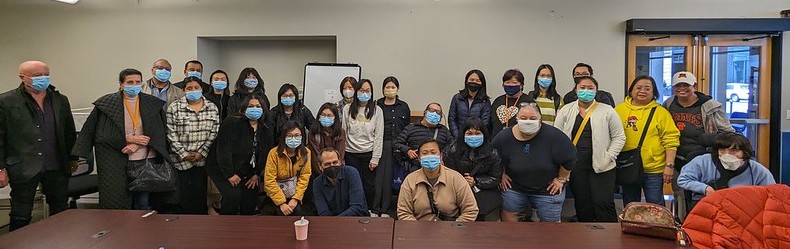
Now, finally, in San Francisco we have the Independent Living Center SF Wheelchair Repair program that does something similar! I went last week to the ILRCSF launch of the program and hung out with Vince Lopez, who is an experienced repair tech and all around great guy. Lana Nieves who heads up the organization welcomed around 40 of us to the spacious conference room, Vince talked about his experience as a tech, we toured Marisol’s assistive tech lending library, and also heard from Michael from Pride Mobility who was there to offer whatever resources and connections he can provide.

a row of masked people in a conference room posing for a group pic

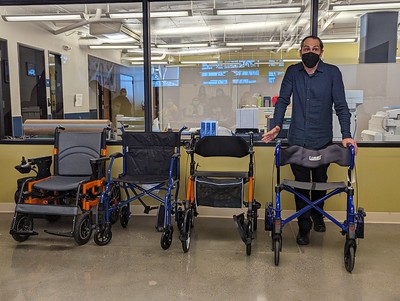
This new wheelchair repair center is funded by San Francisco Disability and Aging Services and is available to San Francisco residents, for emergencies and repair visits within the SF city boundaries. The repair program has limited hours (I think working daytime hours) and you can request either emergency help, or schedule an appointment, by calling their number at 415-609-2555 or emailing info@ilrcsf.org. Vince will come to you if that’s needed with a bag of tools. He can also provide rides to a safe location where you can transfer, in a wheelchair accessible van ride (provided free by Waymo) and even a loaner chair, powerchair, walker, or scooter if he has one available.

a man posing next to a row of loaner rollators, manual wheelchairs, and powerchairs

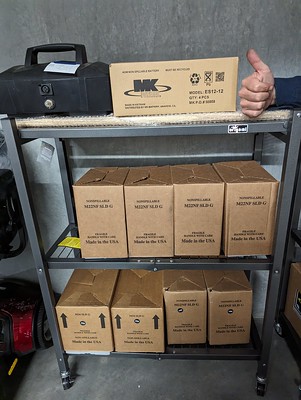
The program is also supported by many wheelchair manufacturers and by MK Battery. (You can get your batteries replaced! Free!!! At least for particular lead-acid scooter and wheelchair batteries they have stocked.)

shelves with new wheelchair batteries in stock

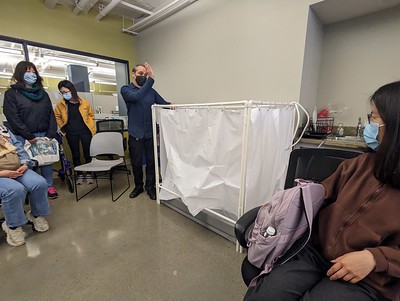
One last nifty service, you can get your wheelchair washed down completely in their portable washing station. I noted it looks like something that is not too hard to build, made from super-sturdy plastic tarp/map base, PVC pipe, shower curtains, a hose, and a pump to drain the water out. (This kind of setup can be used in a kitchen or even a yard for people to wash in if their own bathroom lacks access.)

people in a conference room looking at a wheelchair sized portable wash station

Murderbot’s spa day!!

After the event I got some help from Vince back in the shop. My Whill Ci front fenders break often, I’ve gotten them replaced several times, then lived with the brokenness and loud rattling for probably over a year now, sometimes temporarily fixing it with duct tape and Sugru.

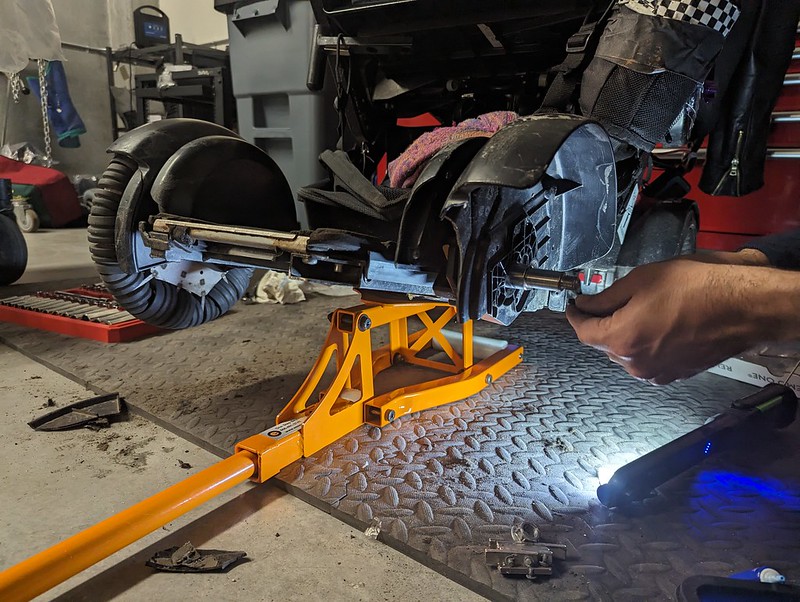
Vince called Whill support, got them to email him the service manual (which I’ve asked for for YEARS and haven’t gotten!) and we got down on the floor to pop the wheels off and figure out what was wrong. While I was on the floor scooting around on my butt, I took the opportunity to wet-wipe the dust off the entire front of my chair.

a powerchair frame up on a jack with its wheel off

Some foam tape, new screws, blue loc-tite, and some cleaning, vastly improved my broken fender and wheel situation. More calls, a quick trip to the nearby hardware store, and a lot of fiddling around fixed my chair! (I got to try a loaner powerchair while all this happened!) And Vince is continuing to investigate if he can wrangle a replacement joystick controller out of the company — another thing I have asked them for but he is apparently the wheelchair support tech whisperer, because he got actual help incredibly fast!

(While I get told to buy a new Model C2; sure, like I just am going to drop 3500 bucks when I could fix my current chair?!) Fortunately now we have California’s new Right to Repair law to support our efforts to maintain our incredibly critical assistive tech! So when I do get a new powerchair eventually, the manufacturer will have to keep its parts available for at least 7 years.

My chair’s fenders no longer rattle, which is great, so I can perfect my technique of me + Murderbot sneaking up on people on the sidewalk!

Funding for Disability Justice & Tech!

Are you working as part of a U.S. nonprofit, on disability, justice, and tech? Read this to find out how to apply for DIFxTech grants! The deadline to apply is May 29th.

About the ideas behind DIFxTech grants

DIFxTech funding supports nonprofits working on disability inclusion and justice as it intersects with technology.

As program manager for DIFxTech, I’m doing this work while keeping the principles of Disability Justice in mind,

And the ways we can use tech for good, for our collective liberation, as well as how we need to fight against its misuse.

We wrote our Request for Proposals in collaboration with a committee of other disabled advocates, activists, leaders, policy wonks, researchers, rabble rousers, trouble makers, writers, artists, and nerds,

With funding and support from the Ford Foundation and MacArthur Foundation.

Who can apply

  • Nonprofit organizations in the United States,
  • Where the organization or program is run by and for people with disabilities, and,
  • The organization or program works towards transformational change

How to apply

There are several ways to apply for DIFxTech funding.
The most common is to make an account on the Borealis portal and select DIFxTech 2024.

Other ways to apply

  • JotForm application (may be better for screen reader users)
  • Video or audio formats if that is your preference or access need

DIFxTech can provide the application form in other formats upon request.

Details of the Request for Proposals
If you take the time to read the full request for proposals and FAQ, that will help you decide whether to apply.

And for extra background:

If you have questions

Please, first read the Request for Proposals document!

For further questions or discussion, contact difxtech@borealisphilanthropy.org

What makes access amazing for you?

I was thinking about event accessibility today and events I’ve been to as a wheelchair user. There are bare minimums of accessibility that mean I can get in the door, and usually that’s what people mean when they tell me their space, or event, is wheelchair accessible. A level entrance, a lift or elevator, maybe some specially marked off seating area. But what makes it not just possible, but a good experience? A great, or amazing experience?

I can list some of those things that kick it up a notch!

Good information. Tell me about all the access needs you have considered, whether they come out accessible for me or not, or you were able to mitigate them or not! Just say it as part of the event announcement. It’s a great jumping off point for me to ask deeper questions.

Level entrance that doesn’t depend on a lift. This is about my feeling of security and confidence. Am I going to encounter one of those hellish, clanky lifts that is locked and no one knows where the key is? Is it going to be broken? Is it going to break while I’m in it and a restaurant full of people are staring at me?!

Spaciousness. There is room to move. I can go into a room, and then freely, without fuss or disruption, get out again! I can sit with my friends, whether they are wheelchair users or not. Tables are far apart. Aisles are wide and not blocked by audio visual equipment or people’s backpacks. More than one or two wheelchair users can be in this space and move around and feel FREE.

Bathroom access. This should be obvious but sadly isn’t. Can I get to a level entrance bathroom? Can I do it without going two buildings over and 9 floors up with a freight elevator in between? If not then I don’t even want to be at your event. Is the path to the bathroom clear or will I have to bulldoze my way down a twisting narrow hallway full of mop buckets?!

Community education and participation. The event organizers or hosts mention things like keeping aisles clear and the community understands the reasons for it!

Reachable food and drinks. It is a downer when there’s a gorgeous buffet for your event but it’s up on a weird little dais that has stairs, or it’s so high up I can’t see it from my wheelchair. Yes, people will help me and get my food but it just feels good to be able to independently browse and decide, at my own pace. I can deal with a bar counter height drink ordering experience, and that’s fine, but it’s always nice if there is a low area too and this becomes more important if you are inviting multiple wheelchair users to your event! Decrease the awkwardness by having some low height counter space.

Some seating for other people. It’s a good idea to have this anyway for walking people who get fatigued, but if you make sure there are at least some chairs, that are moveable, then it also means I can get into a space where I can talk to walkies without craning my neck for hours to look up at them.

Accessible presenter setup. Is there a stage? Am I a presenter? Might I be winning an award ? (I like to think so!) Then please make there be an accessible spot for a presenter, a podium or chair, a microphone, place for me to put a laptop and control slides, in a way that isn’t horrible or annoying. I have crawled on stages, I have been lifted onto stages, and I’ll do it but it’s not a great experience. Conference hotel wants to charge you 10K for ramp onto a stage? Maybe get creative with it and at least make there be a level, alternative presentation setup that doesn’t suck.

There’s probably more, but those are the top ones that come to mind!

A thought on current trends in transphobia

As I read Erin in the Morning today citing a lot of pearl clutching freakouts by Republicans about “sex change surgeries on children” (which, by the way, isn’t a thing) in order to drum up hatred and fear of trans people for their own political power grab, I was reminded of the Ashley Treatment.

In 2007 or so there was a public controversy over this procedure that I don’t think was limited to this one girl in Washington. In it, hormones and actual surgery were used on a disabled girl by her parents for a few reasons. They wanted to make sure she didn’t get appendicitis (which I think was probably reasonable); they felt that stopping / slowing her physical growth (via estrogen patches) would help them remain able to care for her in their home since they would be better able to lift and carry her; and, they got her a double mastectomy and hysterectomy because they argued it might make her less likely to be raped (and impregnated) by future caregivers. (Plus no painful cramps or annoying to your caregivers, menstruation.)

Hold up now!!!

That has so many things wrong with it I don’t even know where to start!! For one thing, as if young children don’t get raped or as if not having breasts made you less of a target. I mean you can not have a vagina at all and still get raped. But, anyway….

It has been on my mind today as I think about this ACTUAL surgery and hormone treatment on a very young girl, who had no choice or say in the matter, actually happened, with no giant freak out from the right wing.

Interesting isn’t it?

And, thanks to F.R.I.D.A. and other orgs like DREDF for fighting against the idea that it’s OK to so high handedly modify the bodies of disabled people without their consent.

Pet peeve about local tourist advice

When I am skimming through the various San Francisco related subreddits, there’s one kind of post guaranteed to get me commenting. It’s when someone asks for tips on where to bring their relatives who are elderly and frail and coming for a visit. The responses are almost uniformly ridiculous. Someone is wrong on the internet! I have to intervene!

The kind answers mean well but have no concept of what disability or frailty actually mean. Someone can even specify, my grandma is 95 and can only walk maybe 100 feet, and has a broken knee.

Inevitably there will be advice to take great-grandma on a day long trip around the entire Bay Area.

Sure, just drive 2 hours and then have a 1/4 mile walk at Henry Cowell park! Go the Palace of the Legion of Honor (not horrible advice, but just getting into the building even from the disabled parking spots (and there are only 2 spots) is way more than 100 feet. Blithe advice to rent a wheelchair or use the museum chairs!

I know people want their relative’s visit to be special and I totally respect that.

I guess there are a lot of assumptions to break down:

– An elderly and frail person who may be in some amount of pain, will enjoy a day long outing where they have to sit up in a car
– They even give a hoot about seeing the sights. They are probably there to see you. They have seen a bridge before! Maybe even they’ve seen a lot of oceans! Take them to tea and let them have a nap! Order take out! Jeez!!!
– They just flew here (difficult enough) to SF. Don’t then expect to drive them to Monterey or Pescadero or whatever. That is a lot of traveling time!
– An 85 year old with a limp and has a bunch of health problems is able to do the same things as a 25 year old who has their ankle in a cast for a month and zooms about with a knee scooter. No! Very unlikely!
– Taking the ferry. Always gets suggested since it sounds nice and sedentary and you see the sights. I adore the ferry, but it means a lot of walking and standing in line. It is not a short or trivial distance. I would not be able to do it at all without a power wheelchair. Kind of a bad idea depending on the location (ie, SF, no – bad idea. Richmond, actually, there is parking super close to the ferry terminal but it is still a hike from the car, then up and down those ramps onto the boat.)
– Wildly underestimating distances, because they are trivial to you and you don’t notice them
– Going somewhere loud, overwhelming, and crowded where you have to walk a lot and there is not anywhere to sit (for example, the ferry building – it’s great but be sure you know the walking capacity of your relative)
– Doing all of the above but also adding in some small children. Sure, do all that with some toddlers, sounds like a blast????? Think of the little kids as people with completely different access needs.

Now obviously there must be super energetic adventurous 90 year olds who are game to hop on the cable cars and hike around Muir Woods and so on. If you have one of those as your visiting relative you probably know it!


Fun outings for visitors with limited mobility

So what would I suggest in the cases where someone is visiting and has limited mobility, but no assistive device other than our friend, the automobile? I suggest the following, because these are things that I like to do, and can do, when I’m not walking well but also not using my wheelchair (usually because I don’t feel like loading a giant power chair in and out of the car trunk).

– Pick up or make nice picnic food. Drive somewhere close by, and scenic, where you can either sit in the car, or there is a park bench like 10 steps from the car. Then, and I cannot stress this enough, go home and chill out.

– Land’s End/Sutro baths overlook. You can get out of the car at the Sutro overlook parking lot and it is like, less than 10 steps to sit there on the wall or on a nice bench. Bring a thermos and some cups and have a little mini picnic. Take photos. Very scenic. Bring a bird identification guide (i like the small laminated ones with the most common birds) or a nice map.

– Drive through San Bruno mountain, end up in McLaren Park and have a picnic anywhere you spot a nice bench walkable from the car.

– Fort Funston if the idea of watching people hangglide is interesting to your visitor. The wooden overlook/boardwalk is actually a bit far of a walk for our 100-foot-limit person. Instead – you can either sit in the car right by where the hang gliders take off, or bring folding chairs and set up where you can see them. No need to really walk down there!

– Pacifica Pier Chit Chat cafe. It is tiny but kind of exciting if you like piers and fishing and all that.

– Pillar Point harbor, a little more of a drive but not too far. Barbara’s fish shack is my favorite, and has picnic tables and indoor seating but if there is a line just go to sam’s chowder house. Lovely harbor views, working fishing harbor.

– Consider cab directly to where you want to go if it is a restaurant and then don’t assume you are doing another thing. Do one thing! Then go home! Rest! Relax!

– If you are doing something where you plan to drop off your relative and pick them up think about whether there is anywhere for them to sit while they wait for you. Make sure there is and make the walking distance super minimal. Scout in advance if you don’t know. Also think about where the bathrooms are (like if you walk into a restaurant and it’s minimal distance, that still may be difficult, if they have to walk across the length of a giant building and down some stairs to get to the bathroom – and back!)

– Tea at Lovejoy’s is nice but I also think just going to your own neighborhood cafe or lunch spot if it’s close enough, is great.

– Wheelchairs you rent or borrow in a museum can be great, but make sure your relative is actually willing to sit in one! Will they have fun or will they feel helpless, self conscious, and have to confront all their fears and ableism? Is this the time for processing that?

Other ideas, for not going out:

Ask what shows they like and watch some of that with them.

Do some tech support for them on their phone or device. Like ask what they use it for and what are things that bug them. Fix that shit ! You can do it!

Look at photo albums and talk about the times they show and what you all were doing

Ask for help mending or fixing small stuff

Cook something together that they like to cook

Why does this bug me so much?

I think it bugs me so much because of the entire adult lifetime I have of people assuming I can do things, and them being optimistic, and my own ambitions and pride and enthusiasm on top, getting me into bad situations. “Oh yeah it’s really close” …. only to find that it absolutely isn’t.

As I get older as a wheelchair user and sometimes-short-distance-walker, I’m not even that old, but I certainly have a closer view, I now have more insight about how to slow down and enjoy things in a different way.

So, anyway, I jump into those threads, point out some of the too-ambitious things people have suggested, and mention some easier options.

powering through vs. space to heal

I am in a flare up of my mobility and pain issues (arthritis/joint pain) which means I cannot really do much, am using my manual wheelchair in the house, need to rest quite a lot and am not exactly on the top of my thinking game. Am on prednisone and many other drugs (like gabapentin which makes me feel like a zombie) to deal with it.

The real distinction this time to me is that I can look back over many years of this happening and see the patterns very well. My new normal baseline, in pain and mobility, is pretty decent and predictable and I’m stronger and healthier than I have been since 2005 or so.

So a flare up looks like going from 50 to 10mph rather 30 to 10 to 20 to 15 to 25 to 10 — more of a “suddenly flattened, but temporary” than a hideous wobble in a chaotic unpredictable journey. I feel less afraid that I will be down for a year, and fairly confident that in a couple of weeks I’ll be cautiously bouncing back to normal. Fingers crossed that is true!

It is easier to see what is happening and react appropriately when it isn’t just a hideous chaos of up and down in pain level.

I think the differences are mainly that I know how to manage better, I’ve been wiser in respecting my limits (not THAT much wiser but, better than I was) and limiting what I do — like not traveling a lot and having really consistent sleep. Another difference from 10 years ago is that if I’m in bad pain, I :::stop:::! I stop and rest and adjust my lifestyle and my expectations temporarily, rather than taking pain drugs and powering through ie making it worse.

Now, when I did “power through” it was because I felt I had to, or I wanted to – like going to Vienna to speak at a conference with both feet in soft casts, in a manual wheelchair, by myself, in the dead of winter in the freaking snow. I wanted to do things to be a good parent, or for my career, or because I worried it might be my last chance to travel if my health got worse. I did not want to lose my jobs or career and would end up using all my PTO/sick/vacation time when ill and then feeling under a cloud and then going off on leave when things got unbearable. (Now, I feel like I can take time out of work and come back and trust my job will be there.) So, I respect my past choices, but I’m glad I decided to change my priorities to center more on making space for rest and healing.

This is not at all to imply that anything is “all in my mind” or that the power of positive thinking can cure chronic illness. It took a pretty radical shift in some underlying ways of thinking for me to change my approach (with help from a fabulous, smart therapist) to try to handle my activities and condition in a more sustainable way.

liz in wheelchair with a cat, smiling

Disability Technology Foundation plans

I gave a short talk at the Aaron Swartz Day Hackathon about my new project, Disability Technology Foundation. Its goal is to open license assistive tech of all kinds; to archive and share plans on how to build your own helpful devices, from pen holders to powerchairs. We’ll be aiming to provide an easy pathway for inventors, especially disabled inventors, to freely share the tools they have created with the world. Then, others can try out these devices, share bug reports and troubleshooting or repair tips, and adapt and improve the original designs.

Here’s the talk description:

Disabled people are often locked into using proprietary hardware and software that’s ridiculously expensive, over-regulated, and difficult to maintain or modify.

E-bikes and scooters have great ecosystems for production and maintenance. Yet power wheelchairs, though they use many of the same components as e-bikes or scooters, are locked into a world where they’re unhackable, unfixable, and unrepairable by their owners.

Disabled people do hack their wheelchairs and other assistive technology, including software, hardware for mobility, screen readers, voice banking, AAC, and gadgets to help with limited dex. Meanwhile, engineering students, disability studies folks, and other academics, regularly invent useful stuff. The problem is, most of this stuff does not make it out into the world for practical use.

The time is right for disability justice to combine with F/LOSS! We can build an open ecosystem for assistive tech!

DTF, or Disability Technology Foundation, is Liz’s new venture. DTF will serve as a pathway for assistive technology inventors, hackers, wheelchair modders, etc. to open license their work. That way, they can share it with the world, so that other disabled people can have free access to DIY and low cost plans to build equipment — and make it work for them.

Disability Inclusion and Technology

This year I have been working with the Disability Inclusion Fund to develop a program for DIFxTech. This is a grant and fellowship program meant to support people and organizations who work at the intersection of disability justice and technology.

The request for proposals will be open until October 17th! Here’s some useful links:

* The Request for Proposals (RFP) and an FAQ (Frequently Asked Questions)

* In plain language translation, the same RFP and plain language FAQ.

* The application form in Salesforce or that same application form in JotForm. JotForm may be better for screen reader users.

I want to talk a little bit about why this project is dear to my heart. I’ve worked in tech for many years and I’m (most of the time) visibly disabled as a wheelchair user. I’m often the only physically disabled person in my workplace. I’ve also been involved with local hacker and makerspaces. Computers and the internet have helped me immensely as a disabled person. For example, both in preventing social isolation and in enabling me to work even when I’ve been stuck in bed or in my house. Yet I see so many ways that technology could be a tool for liberation, for movement building, organizing, and connection, and that in what we choose to build, and how we build it, how it is available to people, and what they understand they can us it *for*. I want Nothing About Us Without Us to also mean, the creation of new technologies and our visions of ourselves as disabled people in the creation of the future!

Onward, to the stuff about grants!

What does DIFxTech mean?

As I go around talking with people about the grants, they’re asking me questions like: What does “intersection of disability and tech” mean? Is it like making websites accessible?

Well, yes and no. It can be about taking existing tech and making it accessible for a wider range of people with disabilities. That hits the “disability” and the “tech” parts of DIF, but not the “inclusion!” So, crucially, think of how we design and create technology, and who makes the decisions about that, as well as how we integrate tech into disabled people’s lives. We are looking for work where disabled people are in leadership or equal partnership – that’s the Inclusion part of this equation!

What we are aiming for here is movement building, which is complex to convey. We want to put more disability justice and disability rights into “tech”! That can mean a lot of things. And, we want deeper integration of technology, tech tools, and engineering of all kinds, into communities and movements of disabled people!

Some examples for DIFxTech

To that end, in the RFP, we made a big list of examples of work we’d love to see. The list is grouped into three big categories:

1. We want projects that understand how technology can support disability rights and disability justice. Including,

For example, looking at how algorithmic bias may affect disabled people and what we can do to fix that; policy and legal work to support disability justice in tech; disability justice and technological organizations or companies learning from each other.

2. We want to support projects that make tech development more equal — to democratize tech development, provide collective and equitable access to digital infrastructure, and mobilize cross-disability solidarity in the tech sector.

Some examples: Make accessibile toolchains for disabled engineers, creating technical documentation that’s accessible in multiple formats including plain language translation, improve access to the tools and infrastructure that disabled communities need to bridge the digital divide.

3. Your project could also be about making sure people with underrepresented disabilities can do work with technology.

For example, reframing tech education as it is integrated into disability justice organizations; hosting workshops, hackathons, and conferences where marginalized disabled peoples’ experiences as technologists are amplified and elevated; education for a broad tech sector audience, on disability justice and anti-ableist approaches at the intersection of tech and disability.

Grantees will receive support for 3 years, giving them a longer than usual on-ramp to help their projects get a solid start. We will also aim to connect the grantees with each other, with the larger DIF cohort, and with other organizations and partner opportunities; generally, to give good support beyond the funding itself.

If you have any questions about applying for a DIFxTech grant, please reach out to us at difxtech@borealisphilanthropy.org.

a jumble of wheelchairs and wheelchair parts in a workshop

Got the Rona

After 2 years of being pretty careful we finally got covid. It hit me kind of hard because of having asthma I guess. I’ve been off work for a month, hoping to improve this next week and be back at work but that will depend on whether I can talk without coughing.

It has sucked but I am reasonably good at being sick in bed. One aspect of being disabled that actually helps sometimes! The down sides of having covid while disabled – the logistics of getting to doctors’ office was kind of hairy since I could not handle a) the bus b) driving c) breaking down and putting together either the manual or the powerchair for transport in a car. My sister drove me to to get a monoclonal antibody infusion (TOTAL INFUSION was the hilarious 80s name of the clinic) and then isolated in her basement for days in case I had exposed her. I didn’t want to take a cab. Then at some point I thought about going to urgent care (because my blood pressure was out of control probably from the high doses of prednisone) but could not figure out how to get there without once again asking someone to potentially be exposed and then have to isolate.

I am fine now, just still coughing/ asthmatic when I move around a lot, talk, or laugh. NO LAUGHING ALLOWED. Goal is to quiet this reaction via more inhalers, nerve drugs like gabapentin which apparently help with dry cough, and more tea with honey than seems humanly possible.

I also gained 10 pounds almost instantly from the prednisone and eating whatever I felt like eating, which was: everything.

I missed a bunch of events, concerts, and so on that I had wanted to go to and will probably keep missing them as I will likely go back to work before I am 100% better and the ramp up to Actually Better enough to go out in the evening will be long and slow. So that also sucked.

Luckily the weather was amazing so I spent a lot of time, after the first two weeks where I barely got out of bed, lying on a sort of pallet on the lawn in the garden. I feel very lucky to have a sunny little garden with its astroturf lawn, hummingbirds, finches, and flowers. At first I was getting help from Danny to set up the little bed and drag it back to the Underhouse every day but now I can do it. There is also the hammock and my amazing outdoor claw foot soaking tub. Variety in where you park yourself is really good when you are sick, to keep up morale!

Milo turned 22 and A. is 19. They will likely be going off to grad school (library science) and university (probably in the UK). I’m so proud of them both!

Milo got covid, rather lightly, but was better within a day or two. Danny was pretty sick and slept through nearly a week (some of that isolating in the basement, but we didn’t isolate well enough) and then has been still a little bit sick for maybe 3 weeks or so. He is better now!

SDI & the EDD have been a non ideal experience, as they seem to have screwed up somehow. I think my doc sent in the paperwork but EDD attached it to a claim from 2014 (??!!!!) So my claim is in limbo, it doesn’t have a case number yet, so when I call on the phone I can’t get to the right menu to get a person, and I also can’t send a message since there is no claim to do it from, only a “pending” claim. ARRRRGH.

We are just starting to have people over to hang out in the garden. It’s nice but I find people to be exhausting. I holed up in the room with the door shut kind of a lot just because everything seems irritating and overwhelming and I get a headache quickly if things are overstimulating.

Somewhat inspired by the sudden heavy hitting covid, I started filling out a little workbook called “I’m Dead, Now What?!” that is supposed to gather all the information that would be useful to your survivors or executor of your will. It is interesting to contemplate. Mostly I worry about the giant mess of books, papers, and magazines that I have been lugging around for my whole life and which has NOT gotten any more orderly. What would anyone even do with it? The least I can do is put it in order and sort out anything “important” (LOL? is any of it?). Some of the zines, at least, should go to a good zine archive and/or maybe get scanned. So that will be a goal for this year. Maybe I can hire someone to scan them once I have a pile ready.

I would not call this “Long covid” by the way – Just a long recovery since my lungs got hosed and the exhaustion kind of lingers. I expect in another month I’ll be frisky as ever.